As Global Aid Dwindles, Can African Philanthropy Fill the Gap?
The contraction of global aid is exposing the fragility of a development system that has relied heavily on external resources and priorities. But it is also creating an opportunity to build African philanthropy ecosystems that mobilize local resources, strengthen institutions, and give African actors greater power over the futures they are trying to build.
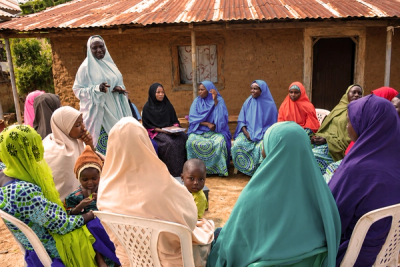
Feature image: Women gather for a savings group meeting in Ngurore, Adamawa State, Nigeria. Such groups provide members with a way to save money, access small loans and invest in their livelihoods.
Photo: Grace Yakubu/CRS
For decades, much of Africa's development story has been told through the language of aid. Donors fund, international organizations implement, local organizations deliver, and communities benefit.
This architecture has financed important work across the continent. But it has also shaped how development problems are defined, how solutions are designed and, ultimately, who gets to make decisions about Africa's future. That architecture is now under considerable pressure.
The Organisation for Economic Co-operation and Development (OECD) projects that official development assistance from DAC donors will fall by another 6.9 percent in 2026, following a record 23.3 percent decline in 2025. Bilateral ODA to sub-Saharan Africa is projected to fall by a further 11.6 per cent this year, after a 26.3 per cent decline in 2025.
For organizations and communities dependent on external financing, these are not abstract numbers. They can mean staff redundancies, interrupted services, and difficult decisions about what program to keep and what to abandon.
So, the question is no longer who will fill the funding gap but what happens when Africa's development ecosystem can no longer assume that external aid will always be there?
The obvious response is to look for replacement funding. But if every donor withdrawal simply triggers a search for another donor, we risk reproducing the very dependency that the current crisis has exposed.
Africa's Resource Base is Bigger than Aid
Across the continent, money sent home by Africans living abroad can rival, and in some countries exceed, official development assistance. Unlike conventional aid, remittances often go directly to households and can be used where they are needed most.
Nigeria is a clear example. World Bank data show that remittances to Nigeria reached about US$22.8 billion in 2025, equivalent to 7.8% of GDP, and more than the $4.13 billion ODA inflows to the country in the previous year.
Most of this remittance supports household needs rather than collective development, and it should not be treated as a substitute for aid. But its scale demonstrates that substantial African-linked capital is already moving across borders.
The question is whether some of these existing financial relationships could, through trusted and voluntary mechanisms, also support community priorities and locally led development.
Remittances are only one part of a much larger picture. Africans have always given. Families support one another. Faith communities mobilize resources. Women organize savings and mutual-aid structures. Communities contribute to schools and local infrastructure. Businesses support social causes. Diaspora networks send money home.
Much of this activity remains invisible in conventional philanthropy statistics. The challenge, therefore, is not to invent African generosity. It is to build the institutions and systems that can recognize, connect, and strengthen these existing forms of giving. That is where African philanthropy has an opportunity to grow beyond charity.
This is not an argument that Africa does not need aid. There is nothing progressive about celebrating the withdrawal of resources from countries where those resources support healthcare, education, humanitarian assistance, and civil society.
The recent contraction of aid will have real consequences. In Nigeria, for example, the 2025 USAID funding freeze disrupted health and humanitarian programs, including treatment for nearly 1.9 million people receiving antiretroviral therapy. Humanitarian operations in the conflict-affected northeast were also affected, while local NGOs faced severe financial pressure, including significant staff reductions.
Nigeria is not the whole of Africa, and its experience is not a universal template. But it offers a useful window into a broader continental vulnerability: when external financing becomes a critical part of an organization's operating model, decisions taken elsewhere can quickly become crises at home.
Nor can philanthropy simply replace public finance. African foundations cannot substitute for functioning governments, domestic revenue systems, or public health institutions.
The issue is therefore not whether Africa should reject international solidarity. It is whether African countries can build stronger domestic and regional resource ecosystems alongside it.
From Beneficiaries to Actors
Philanthropy Circuit's Beyond Aid framework offers a useful starting point: move from need to agency, from external solutions to local capability and leadership, and from seeing communities as beneficiaries and seeing them as builders, actors, and decision-makers.
This is more than a language change. It is a question of power. Who defines the problem? Who decides what is worth funding? Who determines the timeframe? Who decides what counts as evidence? And who carries the risk when an experiment fails? These questions matter whether the money comes from an international donor, an African foundation, a corporation, or a wealthy individual.
African philanthropy should therefore not simply reproduce the short-termism and project-driven approaches that have sometimes characterized international aid.
A stronger philanthropic ecosystem would support the institutions and conditions that allow social change to take root: women's rights organizations building long-term capacity; civic organizations strengthening accountability; African research institutions producing knowledge that shapes policy; community organizations receiving flexible funding because they are closest to the problem; and innovators given the space to experiment and sometimes fail.
This is where philanthropy has a distinctive role. It can take risks that governments and commercial investors often cannot. It can provide patient capital and support public-interest work that has no obvious financial return. But that freedom comes with responsibility.
Nigeria: A Case Study in Vulnerability and Possibility
Nigeria's experience following the USAID freeze illustrates both sides of this challenge.
According to an unpublished study, The USAID Freeze: From Aid to Agency research, organizations responded to the funding shock by cutting costs, prioritizing essential services, exploring social enterprise and new revenue models, repositioning themselves as technical partners to government, and strengthening collaboration across civil society. Domestic philanthropy, corporate social responsibility, and diaspora giving also received renewed attention.
None of this means Nigeria has solved its financing problem. It has not. What the crisis did was expose resources and capacities that had often sat outside the center of the development-financing conversation.
The country has also begun developing philanthropic infrastructure. The Nigeria Philanthropy Office and its I-Philanthropy platform are intended to connect donors with causes and improve transparency around giving. The research describes these efforts as promising but still nascent, requiring stronger ecosystem support, better documentation of local giving, and greater collaboration among philanthropists, corporations, and communities.
These initiatives are not replacements for aid. They are pieces of a broader architecture. That is the lesson other African countries can examine in their own contexts, not necessarily replicate.
Kenya's philanthropic ecosystem will not look like Nigeria's. Ghana's will differ from South Africa's. Community philanthropy in Uganda will have characteristics different from those of diaspora giving in Nigeria. The point is not uniformity. It is greater agency and resilience within African philanthropic ecosystems.
African-led must also mean accountable
There is, however, an important caution. In challenging donor-driven development, we should not romanticize everything that is locally led. African institutions can reproduce inequality. Local elites can capture resources. Corporate philanthropy can become public relations. Political connections can influence funding. Civil society organizations can struggle with governance and transparency.
Nigeria's experience illustrates this. The USAID Freeze research identifies a trust deficit between civil society organizations and potential domestic funders as one barrier to local fundraising and points to stronger financial reporting, governance, and transparency as important to building credibility.
If we want Africans to give more to African organizations, those organizations must also be prepared to demonstrate how resources are governed and what they achieve. Trust cannot be demanded. It has to be built.
This is why the Beyond Aid framework's emphasis on evidence is important. Its "Evidence Triangle" brings together lived experience, data, and institutional insight rather than allowing one perspective to dominate the story.
The same principle should inform philanthropy. We need to know not only how much money is given but also where it goes, who makes the decisions, who benefits, and what changes.
The Opportunity is to Diversify Power
It would be a mistake to frame the future as a choice between international aid and African philanthropy.
Africa needs a broader financing ecosystem. Governments must mobilize domestic revenue and provide public goods. Businesses and investors have roles to play. Diaspora communities already contribute substantial resources. Philanthropic institutions can take risks and finance public-interest work. Development finance institutions can provide capital at different scales and on different terms. International partners will remain important.
The question is how these resources interact and who has the authority to set priorities.
The Nigerian research points towards this kind of ecosystem: mobilizing philanthropy, impact investment, corporate social responsibility, and diaspora capital; strengthening locally financed civil society; and creating platforms through which government, business, philanthropy, and other actors can collaborate and learn.
The aim should not be to replace every dollar of foreign aid with a dollar of African philanthropy. That is neither realistic nor desirable.
It should be to create a system in which external funding is one source of support rather than the organizing principle of development and in which African actors have substantially greater influence over the priorities, resources, and institutions shaping their futures.
What Comes After Aid?
There is a temptation to describe this moment as the "end of aid." Perhaps that is too simple. Aid will not disappear overnight, and international solidarity will remain essential, particularly in humanitarian crises and countries facing severe fiscal and institutional constraints.
But the era in which Africa's development ecosystem could assume a relatively stable supply of external development finance is clearly under strain. We should pay attention to what that disruption is revealing.
Nigeria has shown both vulnerability and resilience. Across the continent, different forms of local giving, diaspora finance, community action, philanthropy, and institutional capacity are already present. The challenge is to build the infrastructure, governance, and trust to mobilize them more effectively.
Africa does not need to prove that it can develop without the rest of the world. That is the wrong standard. What it needs is a development ecosystem in which international partners are partners rather than patrons and in which African actors have greater power to define problems, set priorities, allocate resources, and shape solutions.
That is what it should mean for African philanthropy to grow up.
The end of aid as we know it may be a crisis. It can also be an invitation to recognize the resources already within African societies, build the systems to mobilize them, and put agency, not dependency, at the center of the continent's next development chapter.
About the Author
Senior Guest Contributor
Olufunke Baruwa is a Nigerian international development and gender expert with more than two decades of experience spanning government, civil society and international development. She is a former CEO of the Nigerian Women’s Trust Fund and former Regional Program Officer for Gender, Racial, and Ethnic Justice at the Ford Foundation. She also previously worked as a project management specialist with USAID Nigeria. Her work has focused on gender equality, social inclusion, public policy, governance, and philanthropy.
View all articlesRelated Narratives
As Global Aid Dwindles, Can African Philanthropy Fill the Gap?
The contraction of global aid is exposing the fragility of a development system that has relied heavily on external resources and priorities. But it is also creating an opportunity to build African philanthropy ecosystems that mobilize local resources, strengthen institutions, and give African actors greater power over the futures they are trying to build.
Building Safe Spaces For the Next Generation
The organizations doing the most meaningful work in African communities are rarely the ones with the loudest voices. In the Narrative is our response to that reality. Each month, we profile one selected organization doing real community-driven work on the continent and make sure their stories reach the people who need to hear them. These are their stories, told in their own words. This edition features Peter Kimani, Chairperson, Blossoms of Ghetto, a community-based organization working with vulnerable children and families in Mathare, Nairobi, and here is what he had to say.