
What an Umlazi Savings Circle Reveals About Philanthropy
How South African households, communities, and institutions quietly finance resilience outside dominant aid narratives.
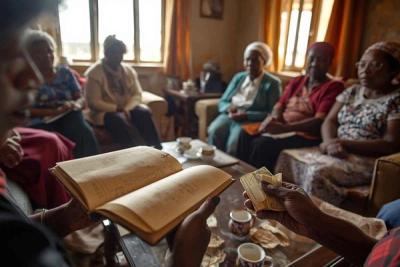
On the first Sunday after payday, Nomusa Khumalo arrives at a neighbor's house in Umlazi carrying a notebook, a pen, and R500 folded neatly inside her handbag. She greets the women already seated in the lounge, where tea has been poured, and names are being called from a ledger worn soft by years of use. By midday, the money collected in the room will help buy groceries for one household, cover funeral costs for another, and pay school expenses for a child returning to class. Some of the cash comes from wages earned nearby. Relatives working there sent some cash overnight from Johannesburg. None of it, however, will appear in global aid statistics. Yet this, too, is a critical contributor to development.
This gathering is common in homes, churches, and community halls across KwaZulu-Natal, where savings clubs, burial societies, and family transfers have long moved money to where it's needed. People call this a coping mechanism. It's also philanthropy—just not the kind that shows up in anyone's annual report.
For decades, international coverage of Africa has run through charity drives, humanitarian appeals, and foreign-funded solutions. None of that is false, but it is also incomplete, as it does not take cognizance of the networks of local giving that run every day without a donor conference or an annual report.
In Umlazi, one of South Africa's largest townships, unemployment, rising food prices, and mounting household pressures are part of daily life. So is the community's response. When a child needs school shoes, a family must pay for a funeral, or a broken fridge threatens to spoil the month's groceries, neighbors often step in before any formal institution is called.
The Numbers Behind Everyday Giving
South Africa is one of the world's most unequal countries, with wealth still sharply divided along racial, geographic, and class lines, according to the World Bank. The economic pressures are reflected in the labor market: Statistics South Africa reported that unemployment rose to 32.7 percent in the first quarter of 2026, the highest level in five years. Those pressures help explain the enduring role of stokvels. The National Stokvel Association of South Africa estimates that nearly R50 billion circulates through more than 800,000 groups with a combined membership of about 11 million people each year.
What appears informal is, in practice, organized finance. For Nomusa’s group in Umlazi, those national figures become something immediate. Twelve members contributing R500 each creates R6,000 in a single meeting, which is enough to cover a month’s groceries for one family, contribute toward registration fees, or prevent a household from turning to high-interest lenders. Repeated across thousands of homes and community halls, such sums form part of a parallel economy of resilience.
Burial societies reveal a similar logic. In communities where funeral costs can destabilize already stretched households, monthly contributions function as pooled insurance, ensuring that grief does not immediately become debt. Church collections often do the same, funding transport to clinics, student bursaries, or food parcels when income runs short.
The pattern repeats itself across the continent. According to the World Bank, remittance flows to Sub-Saharan Africa amount to tens of billions of dollars annually, in several countries exceeding official development assistance. Development economists may classify these as private transfers, but families experience them as lifelines.
Behind those figures are migrants sending money for rent, medicine, tuition, and survival. In South Africa, internal remittances are just as significant, though less discussed. Salaries earned in Gauteng or urban centers are routinely redistributed to households in provinces such as KwaZulu-Natal and the Eastern Cape. A transfer sent on Friday can become groceries on Saturday, taxi fare on Monday, and exam registration by Wednesday. It is financial flows between Africans, such as these, that are structured acts of care through mobility and mean far more than the simple act of electronic funds transfer and transactions.
Who Gets Counted as a Donor?
Not all giving is recognized equally. Some forms arrive with press releases, audited reports, and ribbon-cutting ceremonies. Others move quietly through WhatsApp messages, envelopes passed across kitchen tables, church collections after Sunday service, or monthly contributions recorded in worn exercise books. Both redistribute resources. Only one is consistently treated as philanthropy. Family trusts, faith institutions, and community organizations fund education, food relief, entrepreneurship, and health initiatives across the country, among others. These formal institutions matter, and many fill urgent gaps left by state capacity constraints and persistent inequality. But to focus only on large checks and public announcements is to miss the wider architecture of giving that sustains daily life.
This is where philanthropy poses questions around who gets recognized as a giver. Which flows of money are labeled "development finance," and which are dismissed as "private survival strategies"? All questions centered on who sets the agenda in the international arena of giving and who holds the power. When large international grants are announced, they are often framed as transformative, but when township women pool savings to educate children or bury neighbors with dignity, it is treated as merely cultural and in isolation from global economics.
This distinction says less about impact than about whose systems are considered legitimate, and again, who the power belongs to.
As the late Malawian economist Thandika Mkandawire argued in broader development debates, African societies must be understood through their own institutional capacities rather than only through external prescriptions. Informal giving networks, mutual aid systems, and community finance are part of that institutional life, even when they sit outside formal policy language. Seen this way, the women gathered in Umlazi are not operating at the margins of development as dominant narratives suggest, but are instead, participating in one of its oldest functions, where they pool risk, allocate resources and expand possibilities where markets and institutions fall short.
Rethinking the Narrative
There's a difference between talking about Africa and the world and talking about Africa in the world. The first treats the continent as separate until a donor or institution reaches in. The second is closer to the truth: African societies have always generated their own resources and systems of care. The Cameroonian philosopher Achille Mbembe has argued that Africa has always been entangled in global histories of labor and extraction, not separate from them. The Senegalese economist Felwine Sarr has pushed for Africa to be read as a site of invention, not a permanent crisis.
African philanthropy is where that argument gets concrete. It shows African actors shaping development agendas instead of just receiving them—financing education, cushioning inequality, and preserving dignity, mostly uncounted. "Africa is rising" has become a slogan. But if it means the capacity to solve African problems with African money and African leadership, philanthropy is some of the clearest proof of it.
Back in Umlazi
By late afternoon, the meeting is ending. Names are checked off, receipts noted, and next month’s host is confirmed. Nomusa says her share of this round will help pay registration costs for her daughter’s college application. Another member plans to repair a leaking roof before winter deepens. Someone jokes that next month’s tea must be stronger. Laughter fills the room before chairs are stacked away. No one here describes what happened as global development. No one calls it a philanthropy strategy, yet resources were mobilized, and opportunity was financed.
That is why language matters. South Africa is not waiting on the edge of the world for solutions to arrive. Through acts like these, small in appearance but vast in cumulative effect, we see what has long been true: Africa is not beside the world; instead, it is actively in it. This is a reality too often missed in dominant narratives. Beyond aid, here lies the everyday force of African agency.
Africa is not waiting for help. Africa is already at work, moving itself forward, beyond aid.
About the Author
African Philanthropy Media Fellow
Tatenda Mbili is a Master’s student at Wits Business School studying African Philanthropy and Social Investment. She recently completed Philanthropy Circuit’s African Philanthropy Media Fellowship.
View all articlesRelated Narratives
Building Safe Spaces For the Next Generation
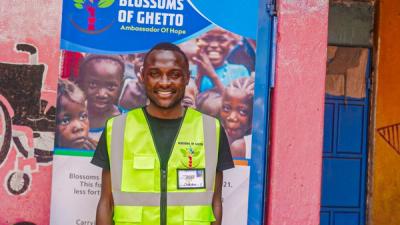
The organizations doing the most meaningful work in African communities are rarely the ones with the loudest voices. In the Narrative is our response to that reality. Each month, we profile one selected organization doing real community-driven work on the continent and make sure their stories reach the people who need to hear them. These are their stories, told in their own words. This edition features Peter Kimani, Chairperson, Blossoms of Ghetto, a community-based organization working with vulnerable children and families in Mathare, Nairobi, and here is what he had to say.