We Keep Funding Africa’s Problems. What About Its Possibilities?
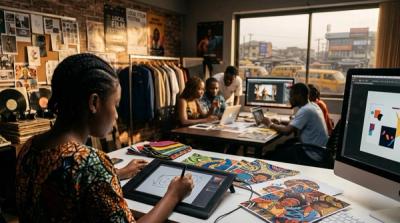
Feature image: AI-generated image depicting young African creatives working together, reflecting a growing push to invest in the continent’s talent, ideas, and creative industries.
If you are anything like me, you have used your imagination to build mansions, solve world hunger, and transform Africa several times over. You know the conversation. “When I make my $100 million like this, eh…”
In my imaginary budgeting, I would fund African research, back frontier technology, build institutions, invest in resilience,give brilliant young scientists ten-year grants and tell them to go and think. There would be AI labs and climate technology. African datasets, deep tech, and patient capital.
And, if we are being truthful, you have probably looked at people who actually have $100 million and thought, “Ah, ah. Is this really what you people are doing with the money?”
I certainly have. But recently I have been thinking about a harder question.
Imagine the mythical $100 million finally enters your bank account. On Monday morning, someone tells you that $10 million could drastically reduce preventable child deaths. On Tuesday, someone shows you communities where children are malnourished. On Wednesday, you are asked to fund scholarships, hospitals, or emergency relief.
Then, on Thursday, a researcher walks into your office and says, "Give me $10 million. I want to build African AI research capability, train scientists, and create datasets. I cannot guarantee exactly what will come out of it. We may know in ten years.”
Be honest. Where is your money going?
Suddenly, philanthropy becomes less straightforward.
Africa gives. A lot. In more ways than we can count
When we talk about philanthropy in Africa, we often default to international foundations and development agencies. But African giving is much broader than the forms captured in conventional philanthropic data. It includes wealthy individuals paying school fees for dozens of children, families supporting hospitals and community projects, corporate foundations, hometown associations, diaspora giving, and long-standing systems of mutual aid.
It also includes religious giving: tithes, zakat, sadaqah, offerings, endowments, and the enormous amount of social support that flows through churches, mosques and faith-based institutions.
Much of this giving is deeply responsive to immediate and visible needs. Someone is hungry. Someone needs surgery. A parent cannot pay school fees for their child. A community needs a borehole. A family has lost its home. These are real needs, and responding to them is part of what makes philanthropy human.
But it raises a question: How much of our giving helps people survive the present, and how much builds the capability to shape the future?
The tyranny of the urgent
A great deal of philanthropic capital in Africa—whether African or international—is understandably organized around immediate, measurable problems: nutrition, maternal health, child mortality, education, poverty, and unemployment.
These are not lesser problems. They are fundamental questions of dignity.
But there is another category of investment that is easier to postpone precisely because it is less visible: scientific research, universities, advanced technical capability, AI, computing infrastructure, African datasets, research institutions, frontier innovation, and the ability to invent rather than simply adopt.
Their absence rarely produces the same emotional urgency. There is no photograph of the algorithm Africa did not build. No emergency appeal for the patent that was never filed. No fundraising campaign for the scientist who left because she could not fund her laboratory. No collection plate for the research institution that should have existed twenty years ago. And yet those absences compound.
We may be too good at funding symptoms
There is a danger in becoming extremely good at funding Africa’s deficits.
We fund interventions, programs, technical assistance, and capacity building. However, repeatedly training people without investing in the systems and infrastructure that allow them to apply their expertise does not build lasting capability.
What we fund less comfortably is Africa's capability to originate, to produce knowledge, own intellectual property, conduct world-class research, build foundational technologies, determine how African data is used, and shape the technologies that will increasingly mediate African economies and societies.
And this is not just a question for global philanthropy. It is a question for African wealth, family offices, successful entrepreneurs, corporations, churches, and mosques sitting at the heart of communities, even for those of us who say, with great conviction, what we will do when our own $100 million arrives.
Faith-based giving makes the question even more interesting
Religious giving is among the most culturally embedded forms of philanthropy across the continent. Its strength is obvious: it is trusted, local, regular, and close to human need. It feeds people, educates children, supports widows and vulnerable families, funds health care, and responds quickly when communities are in distress.
But imagine if even a small part of that philanthropic energy was also directed toward longer-term capability: a church endowment supporting scientific research; a waqf or other faith-based fund supporting scholarships in advanced engineering; or faith institutions backing research into maternal health, agriculture, climate resilience, or AI for public good. Religious philanthropy does not have to choose between compassion and capability. Perhaps the deeper opportunity is to connect the two.
The things that transform societies do not always fit neatly into a logframe.
Research is speculative. Innovation involves failure. Institution-building takes time. A scientist may spend years working on something whose commercial or social application is unclear. That is difficult for any donor, African or international, who wants visible impact quickly.
“10,000 people reached” is wonderfully measurable. “Probability that this country develops the scientific capability to participate meaningfully in the next industrial era” is somewhat less cooperative.
So capital naturally gravitates toward what can be counted. But what can be counted quickly is not necessarily the only thing that matters most over time.
Then AI arrived
Artificial intelligence makes this question more urgent. Economic and political power will increasingly sit with those who control compute, models, data, talent, and infrastructure.
Africa cannot afford to participate only as a market. African countries cannot spend the next decade discussing AI inclusion while importing the models, datasets, infrastructure, and assumptions on which our societies increasingly depend.
Changing that requires investment now whose returns may not appear in next year’s impact report: training African researchers, building high-quality African datasets, supporting universities, funding experimentation, backing technically ambitious founders, and building public-interest digital infrastructure.
Some of these bets will fail. That is almost the point. If every philanthropic investment has to succeed, we are probably not funding enough genuinely ambitious things.
This is not an argument for choosing AI over hungry children
That would be both morally unserious and intellectually lazy. The question is about how a funding portfolio can hold immediate need, stronger systems, and long-term capability together.
Africa needs capital to address immediate human needs and strengthen health, education, and livelihood systems. It also needs patient, risk-tolerant capital making bets on the scientific, technological, and institutional capabilities that could change what the continent is capable of twenty years from now.
The proportions are debatable. The need for all three should not be. Because there will never be a morning when Africa wakes up and says, "Excellent. Hunger solved. Healthcare is perfect. Education complete. We may now begin scientific research.” The future does not wait for the present to be resolved.
Which brings me back to my imaginary $100 million.
I still intend to spend it magnificently. My imaginary investment committee has approved several African research institutes, an AI fund, some extremely patient capital, and, naturally, excellent governance.
Actual bank balance notwithstanding. But the thought experiment has changed the question I would ask. Not simply: How many problems did this money solve? But also: What African capability exists now that did not exist before this money was spent?
Did we create researchers, institutions, technology, intellectual property, datasets, companies, scientific knowledge, or a greater ability to solve the next problem without waiting for somebody else to fund the solution?
Perhaps the ultimate ambition of philanthropy in Africa – whether the money comes from Lagos, Nairobi, Johannesburg, Dubai, London, or Seattle—should not only be to help Africa solve more problems. It should be to build African institutions and communities with more power to define and solve their own.
This does not mean governments and international partners have less responsibility. It simply asks whether their funding leaves Africans more equipped to shape what comes next.
And when my $100 million finally lands, I promise to act accordingly.
This essay was originally published by Ojoma Ochai on LinkedIn on September 11, 2026. It has been edited and republished by Philanthropy Circuit with the author’s permission.
About the Author
Ojoma Ochai is a Nigerian creative-economy specialist and the Managing Director of Co-Creation Hub (CcHUB), an Africa-wide innovation organization that supports technology and creative entrepreneurs. Before joining CcHUB, Ochai spent about 15 years at the British Council (2006–2021), ultimately serving as Regional Director for Arts and Creative Economy Programmes in sub-Saharan Africa. She worked on programs linking creative practitioners, governments, and international partners and on initiatives aimed at developing Africa's cultural and creative industries. She has also worked on World Bank-supported initiatives involving Nigeria's music and film sectors and has been a member of the UNESCO Expert Facility for the 2005 Convention on the Diversity of Cultural Expressions since 2015. Her academic and professional background includes arts management and computer/network engineering.
View all articlesRelated Narratives
We Keep Funding Africa’s Problems. What About Its Possibilities?
As Global Aid Dwindles, Can African Philanthropy Fill the Gap?
The contraction of global aid is exposing the fragility of a development system that has relied heavily on external resources and priorities. But it is also creating an opportunity to build African philanthropy ecosystems that mobilize local resources, strengthen institutions, and give African actors greater power over the futures they are trying to build.